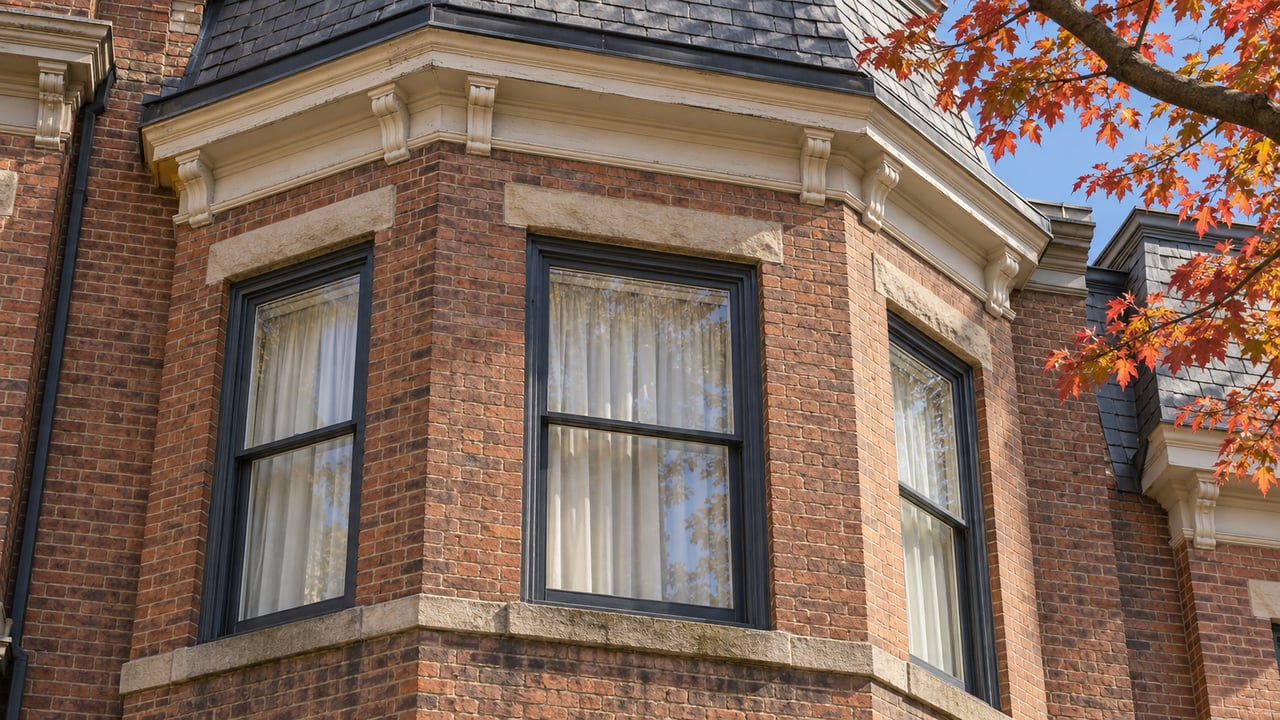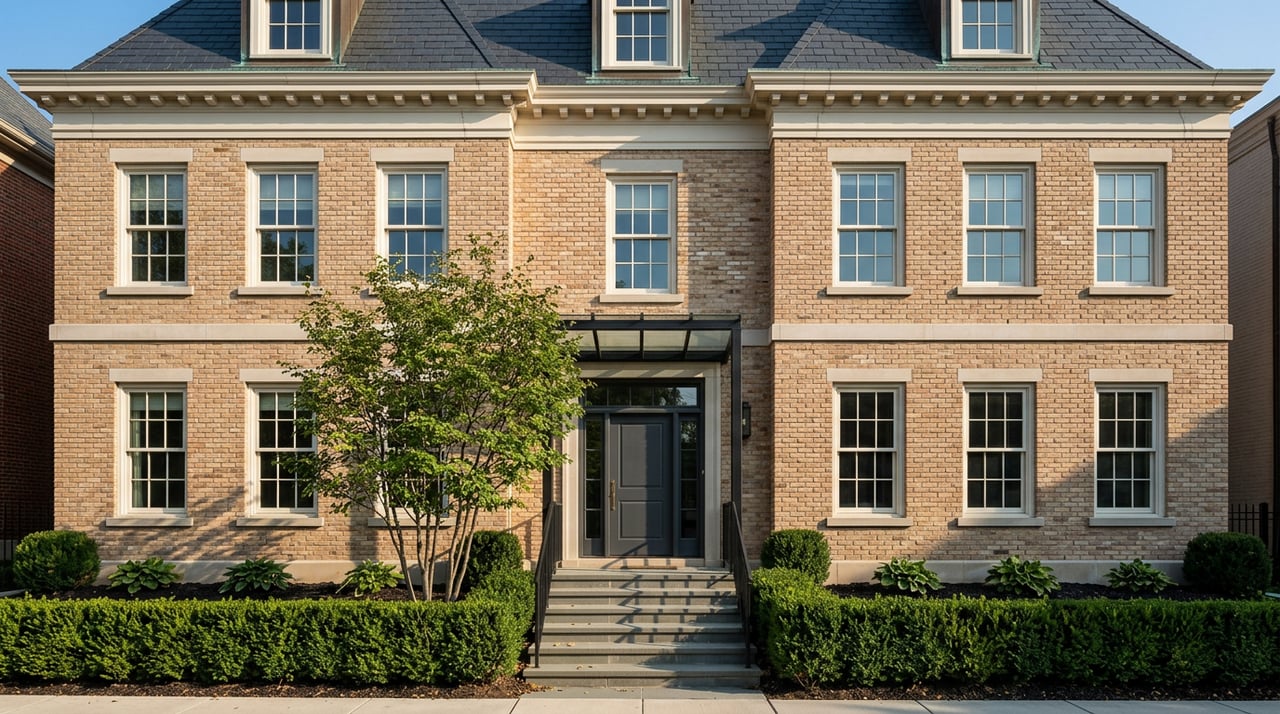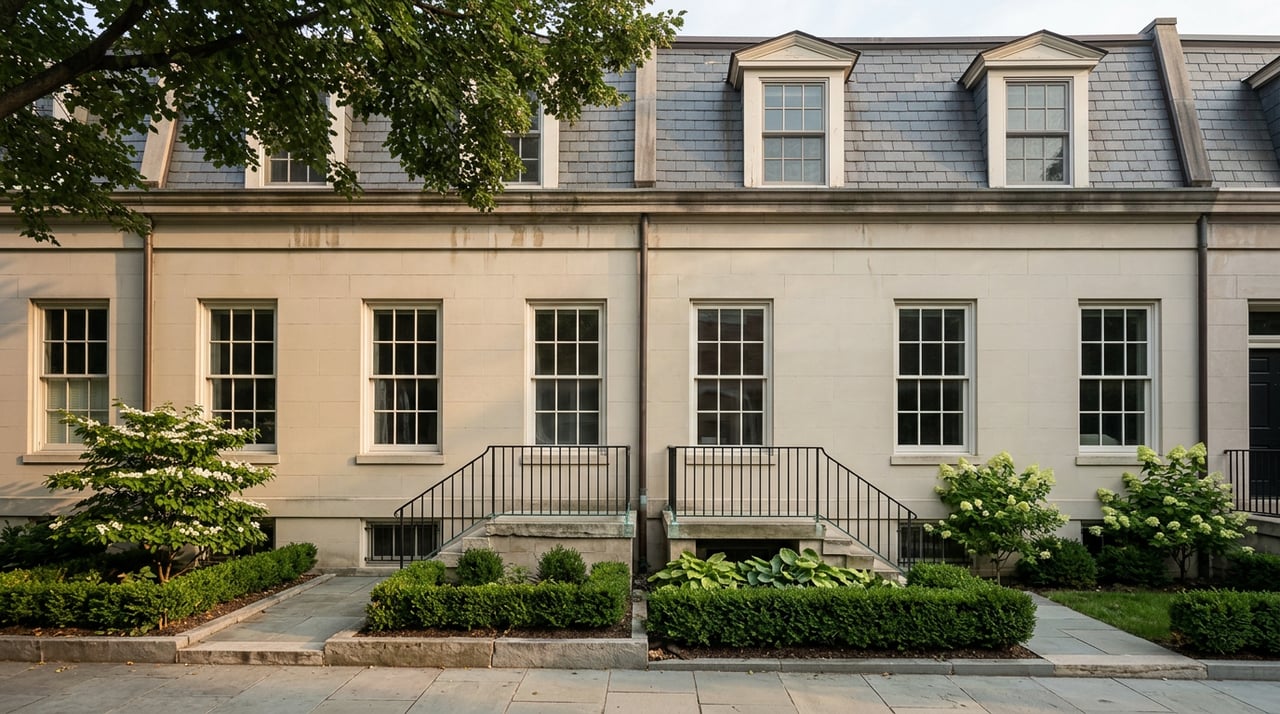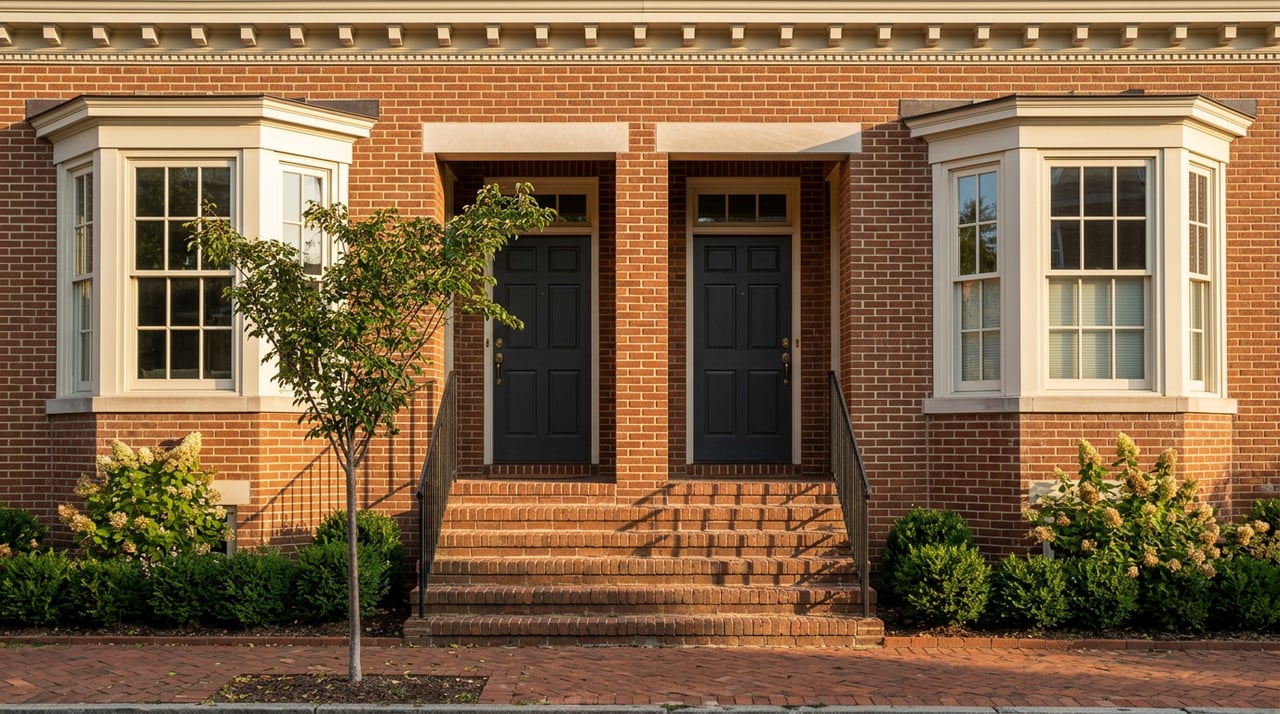
In March, a five-bedroom duplex in Arlington's North Highlands neighborhood sold for $1,610,000. Its neighbor, a four-bedroom home built under the same zoning rules, had sold in December for $1,615,000. Both were built under Arlington's Expanded Housing Option, the ordinance that lets developers put duplexes, triplexes, and even six-unit buildings on lots that used to be zoned for one house each. The policy was sold to Arlington County as a way to bring more attainable housing into neighborhoods where the only new product had become five-bedroom spec mansions. Three years in, the two most visible sales on record land at almost exactly the same price point as a new single-family house.
If you're comparing Arlington to Bethesda, Tysons, or another close-in suburb and you've heard that Arlington "legalized more housing" in a way that should eventually loosen prices, the headline is true and the timing is not what you'd assume. The zoning text changed in 2023. Whether it stays changed has been fought over in four different courtrooms since, and that fight, not the ordinance itself, is what has kept new supply to a trickle.
What the county was trying to fix
Arlington's Expanded Housing Option, universally shorthanded as Missing Middle, passed the County Board on a unanimous vote in March 2023 and took effect that July. It allowed lots previously zoned for single detached houses to hold duplexes, three-unit townhouse groups, or multiplexes of up to six units, generally within the same height and lot-coverage envelope as a single-family home. The county's own study at the time estimated the change would add somewhere between 94 and 108 new middle-housing units over the following decade, a modest number by design, aimed less at transforming the county overnight than at giving buyers priced out of a $1.7 million new-construction house a mid-sized alternative.
That affordability gap was real. A county study using 2019 figures found the average new single-family house built in Arlington ran 4,750 square feet and sold for $1.7 million. Nothing in between existed at scale. The theory behind EHO was straightforward: let builders put three or six smaller units where one large one used to go, and the per-unit price comes down even if the lot doesn't get cheaper.
Three years, four rulings, and a case still unresolved
Here is the part a median-price chart won't show you. EHO has spent roughly as much time under legal challenge as it has spent settled law.
- March 2023: Arlington County Board approves EHO, 5-0.
- September 2024: Circuit Court Judge David Schell rules for the plaintiffs in Nordgren v. Arlington County Board on four of six counts, finding the county failed to properly study impacts like stormwater and sewage capacity before adopting the ordinance. EHO is voided countywide. The county notifies every developer holding an EHO permit that it is no longer valid, and confirms it will not refund the permit fees already paid.
- November 2024: The County Board votes to appeal.
- June 2025: The Virginia Court of Appeals reverses the circuit court, but on a procedural technicality, ruling that the plaintiffs failed to name developers holding EHO permits as required parties to the suit. The ordinance's actual merits are never addressed. The county resumes accepting EHO applications that October.
- April and May 2026: The plaintiffs ask the Virginia Supreme Court to take up the case. On May 19, the court agrees to review it, though only on that same procedural question, not on whether EHO itself is lawful.
As of early summer, no hearing date had been set. A spokesperson for Neighbors for Neighborhoods, the group funding the challenge, told ARLnow he expected the case to reach trial within three to six months of the May ruling, which would put proceedings somewhere in this fall or winter. Nothing about that timeline is guaranteed. If the Supreme Court sides with the plaintiffs on the procedural question, the case doesn't end, it goes back to trial court for a full hearing on the merits, meaning EHO's legal status could still be years from final resolution.
Arlington County's own position, stated plainly on its EHO permitting page, is that the ordinance remains valid law right now and development can continue under it. That's accurate. It's also not the same thing as certainty.
What uncertainty does to a builder's decision
A zoning right that a court can void overnight, with no refund on the fees already paid, is not the same asset as a zoning right settled beyond appeal. That distinction is the part a lot of coverage of this case skips, and it's the part that actually explains why "missing middle" housing is still scarce on the ground.
As of this spring, 59 EHO projects were listed on the county's own permitting dashboard. Since the June 2025 reversal alone, the county had approved nine more projects totaling 40 units. But ARLnow's reporting also notes that amid the legal back and forth, some of those same permitted projects have been converted back into single-family development, presumably because a builder holding a permit that could be erased by a single circuit court ruling has a real incentive to build the thing everyone agrees is legal rather than gamble on the thing currently tied up at the Virginia Supreme Court.
Jason Schwartz of YIMBYs of Northern Virginia put it directly on Virginia public radio this spring:
"It's very frustrating to see the pace of this... I am hoping that the county will not let this permanently bring down EHO."
That frustration is the market signal worth paying attention to. Litigation risk, not the zoning code, is the variable actually throttling how much new duplex and multiplex housing reaches the market.
What the housing that did get built actually looks like, and costs
The product itself is genuinely different from a new spec house. Arlington's 2025 annual data report on EHO, covering permits approved between July 2023 and December 2025, found the following gap between new construction types:
| Home type | Average size |
|---|---|
| New single-family detached | 5,348 sq ft |
| EHO unit, sixplex | 1,259 sq ft |
| EHO unit, townhome-style | 2,378 sq ft |
| All EHO units, blended average | 1,649 sq ft |
Most EHO units come in at three bedrooms, a closer match to Arlington's average family size of 2.97 than the five-bedroom-minimum new detached houses the county was otherwise building. On paper, that's the missing middle doing exactly what it was designed to do.
Price is where the story gets more complicated. The county's own report notes it has limited data to work with, because so few EHO sales have closed. The one sale it could point to as of the end of 2025, in zip code 22201, went for $1,615,000, a figure the report frames as 45 percent below the average sale price of a newly built single-family detached home in that same zip code. Run that percentage backward and the comparison point, the average new spec house in 22201, lands close to $2.9 million. Being 45 percent cheaper than a $2.9 million house still puts you at $1.6 million. It's a real discount against the most expensive product on the market. It is not what most buyers mean when they picture "attainable" housing.
That single sale, and the two North Highlands sales that followed it in December and March, are functionally the entire public record on what missing-middle housing costs to buy in Arlington today. Three data points is not a market. It's an early read, and the early read says these units are pricing closer to a well-located existing rowhouse than to genuinely entry-level housing.
What this means if you're weighing Arlington against somewhere else
If part of your calculation on Arlington has been "wait for missing middle supply to bring prices down," it's worth separating two different questions. Is the zoning legal? Right now, yes. Is enough of it being built, fast enough, to shift entry-level pricing? Not yet, and the case still working through the Virginia Supreme Court means builders have every reason to stay cautious for a while longer.
Over the three months ending in July 2026, Arlington's median sale price across all property types sat at $835,000, up 7.7 percent from the same period a year earlier. That figure blends everything from condos to detached houses, and the type you're shopping for matters more than the county-wide number suggests. Detached single-family homes were trading closer to $1.4 million on average as of late 2025, condos considerably lower. None of that pricing reflects an EHO-driven correction, because there isn't yet enough EHO product on the market to move it.
There is one adjacent trend worth knowing about if you already own in Arlington or are weighing a purchase with future flexibility in mind. Accessory dwelling unit permits, a separate but related tool under the same EHO framework, grew from 47 filings in 2019 to 273 in 2025, and early 2026 filings were running well ahead of the prior year's pace. That's a smaller-scale, lower-risk way homeowners are adding housing and income potential to existing lots, and it hasn't been caught up in the litigation the way duplex and multiplex construction has.
A few questions worth asking before you write an offer
Is it currently legal to build a duplex, triplex, or small multiplex on a single-family lot in Arlington? Yes, as of the county's most recent guidance following the May 2026 Virginia Supreme Court order, EHO remains valid and the county continues to process applications under it.
Could that change again? It could. The Supreme Court's review covers a procedural question, not whether EHO is lawful on the merits, and a ruling against the county would send the case back to trial court for exactly that fight.
Are the new duplexes actually cheaper than a comparable single-family home? Based on the handful of sales recorded so far, not by much, if at all. The one EHO sale the county's own report highlighted priced 45 percent below an unusually expensive new-construction comparison point, and two subsequent North Highlands sales landed in the same $1.6 million range.
None of this means Arlington is a market to avoid. It means the "wait for supply to loosen things up" strategy rests on a court calendar nobody controls, while the existing inventory, condos, older detached homes, and the occasional EHO unit already on the ground, is what's actually available to buy today.
If you're trying to figure out what a specific Arlington block, price point, or property type looks like right now, and what's worth waiting on versus acting on, that's a conversation worth having before you start touring. Giovanna Piskulich works across Arlington and the wider DC metro with exactly this kind of case-by-case read on timing. Start your move with a free consultation and get the specifics for your situation, not just the county-wide averages.